


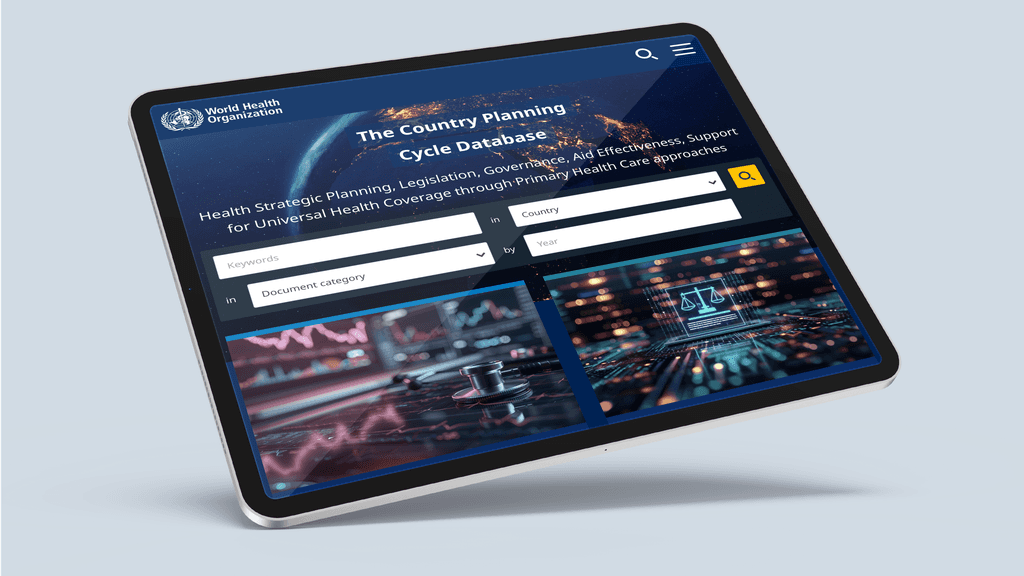
Enabling smarter global health planning through intelligent search and open data
The World Health Organization’s Country Planning Cycle Database (CPCD) is a public digital platform that centralises health policy and planning information from all 194 WHO Member States. Developed by WAAT, it transforms how global health stakeholders access and interpret complex policy, legislative, and financial data. More than a repository, the CPCD uses artificial intelligence, data visualisation, and structured metadata to make sense of vast and fragmented national health information, supporting transparency, better alignment, and stronger global coordination.
The brief: Build an open-access, semantic platform for global health planning
WAAT was commissioned by the World Health Organization to create a centralised online resource for national health policy documents, planning cycles, and legislation from every WHO Member State. The aim was to replace static, siloed datasets with a dynamic, semantic platform that could support policy alignment, facilitate comparison between countries, and strengthen the link between health legislation, strategic planning, and aid flows. The ultimate goal: empower decision-makers with timely, evidence-based insights that drive progress toward Universal Health Coverage (UHC) and the Sustainable Development Goals (SDGs).
Digital solutions: semantic search, open standards, and intuitive design
WAAT combined deep AI expertise with solid open-source foundations to build a modern, scalable, and multilingual platform that transforms data into actionable insight, including:
01
Semantic document search with AI summary capabilities
Powered by Apache Solr, the CPCD includes intelligent search capabilities across thousands of policy documents. Users can filter results by country, topic, or planning cycle, and each document features an AI-generated summary for quick insight.
02
Interactive timelines for health legislation and policy cycles
The platform presents complex legislative and policy data through interactive Highcharts-based visualisations. Each country’s health strategies, laws, and planning documents are mapped on dynamic timelines, allowing users to see the evolution of national policies and detect gaps or overlaps in real time.
03
From Whom to Whom: mapping global health aid flows
A dedicated visualisation module, “From Whom to Whom,” provides a transparent overview of global health aid flows. Interactive Sankey and bubble charts reveal patterns in donor funding and its alignment with recipient countries’ national health priorities. This tool enhances transparency, accountability, and coordination in global health financing.
04
Structured, open data architecture
Built on Drupal 10, the CPCD follows open-data and open-source principles, using a modular, service-oriented architecture. It integrates JSON APIs, automated PDF text extraction, multilingual support, and role-based editorial workflows for WHO staff and national focal points.
05
User-centred design for global accessibility
The interface was developed through an iterative, user-centred process with WHO experts and data consultants. Personas and user journeys were mapped to reflect how policymakers, donors, and researchers navigate complex data. The result is a clear, accessible interface that reduces cognitive load and enables rapid cross-country comparison.
Outcome
The CPCD has become a cornerstone of WHO’s digital transformation, enabling policymakers, researchers, and donors to understand, compare, and align health strategies across 194 countries. For national health ministries, it provides instant access to up-to-date policy frameworks and legislative baselines. For donors and development agencies, it enhances transparency in funding flows and strengthens coordination with recipient governments. For global health researchers, it offers structured, machine-readable data for longitudinal analysis and comparative studies. By combining open-source infrastructure with AI-driven intelligence, the CPCD exemplifies how technology can advance global health governance.
What we did:
AI
Machine Learning
Web Development
Web Design

Bernoullistrasse 20
CH-4056 Basel
Switzerland
Telewizyjna 48
01-492 Warszawa
Poland